The recliner file
A recliner is more engineered than any other seat in the house — levers, motors, a backrest and footrest that move on command — and none of it was ever built to hold a drink. Here's what the built-in cupholder actually measures, why the arm, the lap, and the side table each fail differently once the footrest goes up, and what a fix has to do instead of matching one more hole to one more cup.
The drop-in cup molded into a recliner or theater-chair armrest is a specific manufactured part, not a rough guess. Replacement inserts run about 3 1/8 to 3 1/2 inches across the inside, only 2 to 2.5 inches deep, with a 4 to 4.4-inch outer lip. At the small end, some theater-chair cupholders measure just 2 5/8 inches — only barely wide enough for a standard can, itself about 2.6 inches at the base. That sizing predates the insulated tumbler class most people carry to the chair now: a base that clears the opening on diameter alone is still standing in a socket only 2 to 2.5 inches deep, and a foot-tall tumbler in a socket that shallow is mostly lever and barely socket.
Depth isn't the only weakness built into the part. Condensation sticks a sweating cup to the plastic insert, and lifting the drink lifts the whole holder out of the armrest with it — commercial theater operators have described switching to stainless cups for exactly this reason. Replacement cups are sold with drain holes because condensation pooling inside them is routine, and cheap plastic ones held only by their top flange are known to crack at the bottom under regular use. And a large share of recliners in homes have no cupholder to fail in the first place — one major recliner maker's own dealer materials describe going many years without a single-chair cupholder model, since cupholders traditionally lived in the console between two loveseat seats instead.
Once the socket is out of the running, the next surface is the arm itself — padded, rounded or sloped on top, shaped for a forearm rather than a glass. There's no flat plane anywhere along a rolled arm, so anything set there rides the curve from the moment it's set down, not just once the chair starts to move.
The other default is your own lap and legs once the footrest is up — a drink clamped between the knees or balanced on the belly for the length of a movie. That's a grip, not a holder, and a recliner evening is a long list of moments that need the hand back — the remote, the blanket, a second helping. Owners setting up dedicated theater rooms without built-in holders describe exactly this: soda bottles held between the legs for an entire film because there's nowhere else for them to go.
A side table looks like the obvious fix, until the layout math gets involved. Placement guides recommend parking it 2 to 4 inches behind the armrest line so it doesn't interfere with the chair tilting back, with a comfortable reach pegged at 20 to 24 inches horizontally from the shoulder — and the same guides say to test that reach while reclined before you buy. A table positioned to survive the mechanism is a table sitting behind your elbow the moment you lean back; the layout rules that keep a coffee table clear of the footrest's swing zone protect the furniture, not your reach.
Plenty of rooms with a recliner set never had table space to begin with — one owner of a three-piece set described family visits ending with nowhere to set a soda or a plate but the floor. The one furniture format actually built with drink storage in mind, a reclining loveseat's console, only serves the two people flanking it, fixed in place at hip level and set back enough that seating guides warn it can land too far behind the shoulder to reach comfortably. Everyone else in the room is back to the arm, the lap, or the floor.
The fixes people already own tend to fail in a specific, on-brand way. A fabric caddy that straps over the arm sits on the same slope the arm gives everything else, and owners commonly report it sliding off the chair entirely; fabric also absorbs a spill instead of stopping one. A cupholder expander adapter widens an existing socket, typically from around 3.15 inches, to accept drinks measuring as much as 3.6 inches across — but it only helps a chair that already has a compatible holder. The classic recliner with no cupholder, and the 2 5/8-inch theater cup already too small to adapt, get nothing from it.
Swivel tray tables and socket-mounted trays need an exact cupholder diameter that isn't standardized across furniture brands, so owners often measure their own chair and still can't find a matching size, and a loaded tray levers against the small plastic cup it's plugged into until something gives; a branded version lists near 440 dollars, and owners of cheaper clamp-on versions report the tray tipping the moment real weight leans on one side. The DIY route goes straight to the drill: automotive cup holders bolted to the armrest front, PVC pipe, and marine hardware whose own drain holes let spilled soda or popcorn oil run straight through to the carpet — and the add-ons snap off the first time a coat sleeve catches one.
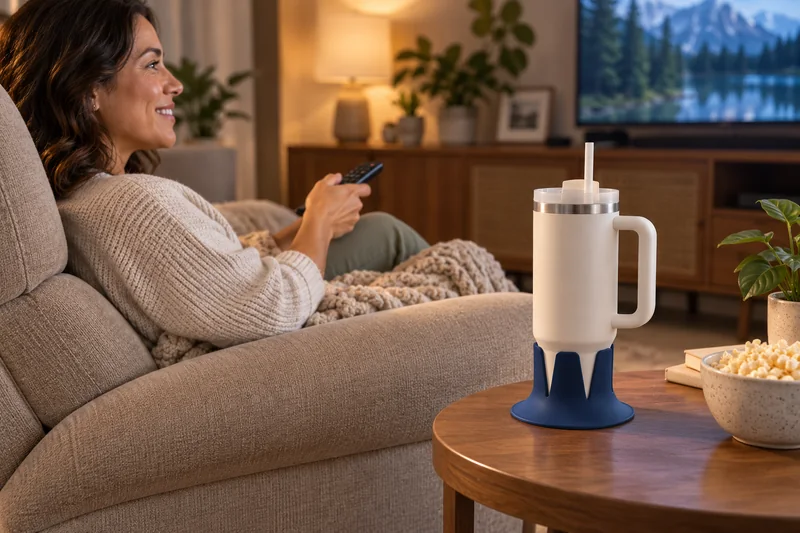
Every one of those failures traces back to the same mismatch: a small, rigid base meeting a surface that's padded, sloped, sized for something else, or about to move. A wide, flexible base laid across an armrest or a lap spreads its footprint over the padding instead of pressing a single point into it, so it doesn't sink and lean the way a narrow cup does. From there, flexible fins hold the drink by its bottom inch — a grip a shallow drop-in socket never gets, since that socket only touches the sides for 2 to 2.5 inches of a much taller tumbler.
The fit has a floor as well as a ceiling: a base from 2 to 3 inches across settles in fully, and the fins flex to about 3.15 inches for a snug fit at the top end — enough for the Stanley 30 oz H2.0 FlowState Quencher's 3.15-inch base and the Stanley 40 oz model's 3.1-inch base, without the diameter-matching lottery an adapter or a socket tray runs into.
None of that requires the chair to hold still. The backrest tilts, the footrest swings out, a rocker rocks — the base flexes with whatever it's resting on and settles the drink back level as that surface moves. It resists tipping; it doesn't override a hard, direct knock, but the slow, repeated motion a recliner actually makes through an evening is exactly what the shape is built around.
None of that gets solved by balancing more carefully on a rolled arm, or matching one more adapter spec to one more socket — it gets solved by giving the drink its own wide, flexible base that doesn't care what cupholder, if any, the chair came with.
Bring one home from steadilabs.com →Purchases go through steadilabs.com — the maker, directly.